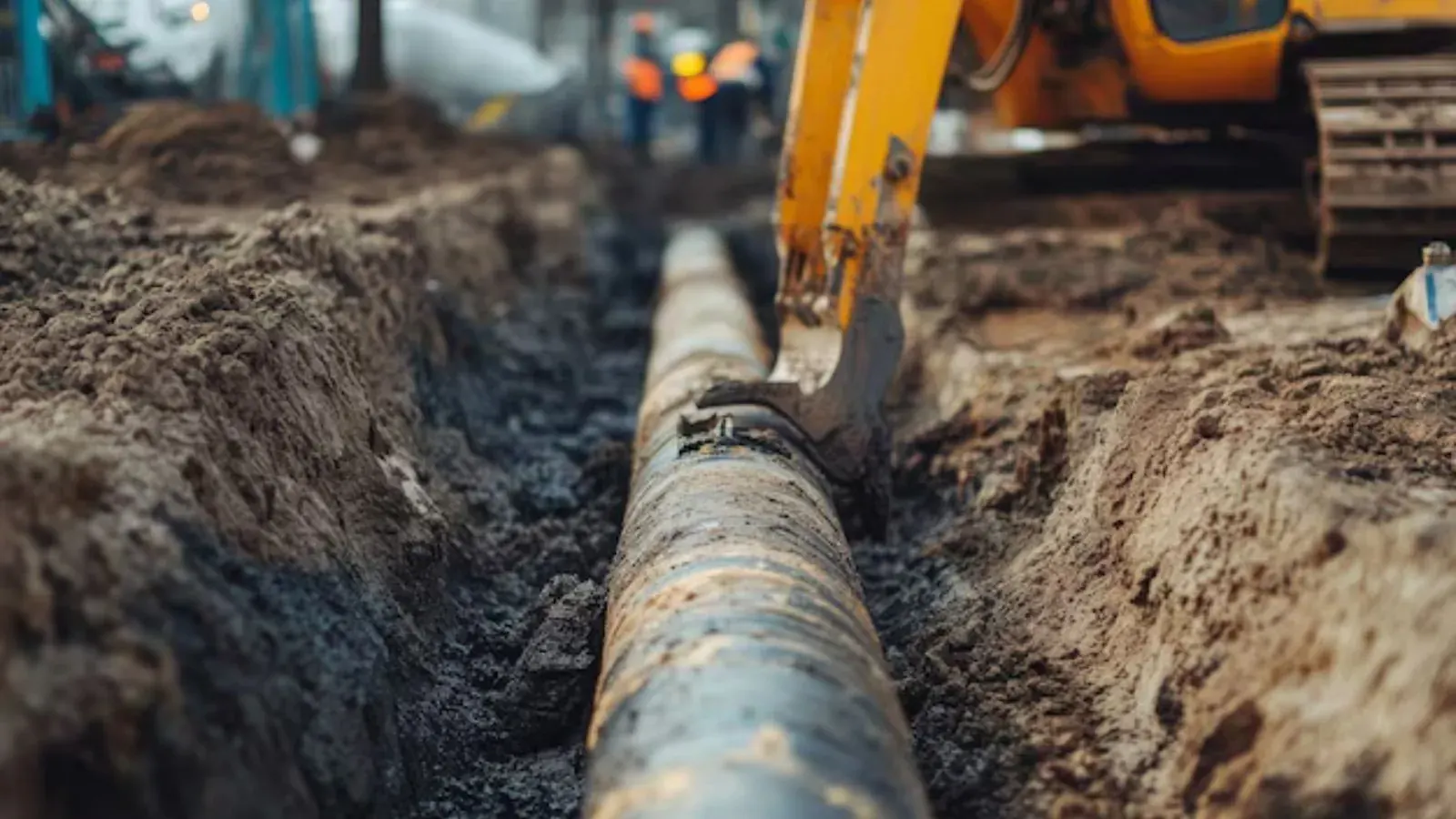
Your water service line is the buried pipe that carries water from the main in the street to your meter and into the house. When it fails, you may see a wet yard or lose pressure. Water line repair in Dedham, MA is often a two-party problem, so we start by working out where the failure sits.
Our 24/7 dispatch handles calls at night and on weekends. Meanwhile, close the main valve inside.
Geyser in the yard, no water, or a flooded meter pit.
Water bubbling up in the yard, a meter pit that is overflowing, or a house that has no water at all points to the service line. These are the signs the Dedham-Westwood Water District (DWWD) lists as warning signs of a service-line leak, along with low pressure and discolored water.
If water is visible, shut the main valve inside the house first. If the shutoff does not hold, or the water is pouring from the street side of the meter, call DWWD at 781-326-1250 after hours or 781-329-7090 during office hours. That is the line for main breaks and anything on the District's side. Then call us for work on your side.
Where the District's job ends and yours begins.
DWWD supplies water in Dedham and handles the main in the street. The service line then runs to your meter and into the house. The homeowner generally owns the pipe on the house side of the connection, but the exact boundary is not something we can state for your address. Ask DWWD where its responsibility ends before you hire a dig.
That one question can save a lot. If the failure is on the District side, the repair is theirs. If it is on yours, the plumber handles it and arranges the permit. A good plumber will help you ask the right question and will not start excavation until the boundary is clear.
Water line down? Talk to a dispatcher about the next step.
Call (617) 752-0573Signs of a water service line leak.
- A water bill that jumped with no change in how you use water..
- A meter that keeps moving when every fixture is off..
- Low pressure at every faucet at once, not just one..
- Cloudy, brown, or discolored water after a leak or repair..
- A soft, soggy, or unusually green strip of lawn between the street and the house..
- Water standing in the meter pit or at the foundation where the line enters..
- A hissing sound near the main shutoff or meter..
Low water pressure: line problem or fixture problem?.
Low pressure at one faucet is usually a clogged aerator or valve. Low pressure at every tap, including the hot and cold sides, suggests something upstream: a partially closed main valve, a failing pressure regulator, a corroded line, or a leak that is bleeding off flow.
Run a simple check. Test a hose bib outside, then a faucet on the highest floor. If both are weak, the issue is probably before the branches split. A plumber can put a gauge on a hose bib to read static pressure, which separates a supply problem from a house problem. If the reading is normal and one fixture is weak, it is a faucet repair job, not a water line job.
How a plumber confirms a buried break.
Before anything is dug, a plumber should confirm where the leak is. Methods include a meter test to prove a leak exists, a pressure test of the line, and acoustic listening gear that picks up the sound of escaping water. Ask whether the plumber brings listening equipment, since not every crew does.
A leak under pavement, a driveway, or a root mass is harder than one under open lawn. Be wary of a quote that begins with a trench and no diagnosis. For hidden leaks in general, see our leak detection page.
Repair, trenchless, or full replacement.
| Option | Best when | Trade-off. |
|---|---|---|
| Spot repair | One failure in sound pipe | Leaves older pipe in place. |
| Trench and replace | Pipe is corroded or old | Digs up lawn or paving. |
| Trenchless pull | Landscaping or paving is hard to disturb | Needs access pits at each end. |
| Reroute | Old line path is blocked or shallow | Longer new run. |
A spot repair is the right call when the pipe on both sides is sound. Replacing the whole line costs more now but stops repeated digging. Ask the plumber to show you the removed pipe and to explain why they chose the option.
Whatever method is used, the new line belongs below the 48 inch frost depth listed in the state building code, 780 CMR, or it can freeze in a hard winter.
Lead service lines and what DWWD says.
DWWD's 2025 water quality report says lead in drinking water comes mainly from service lines and home plumbing, and that there is no safe level of lead. That does not tell you what your line is made of. Older homes may have older service lines, and the Town's Master Plan says 74 percent of Dedham houses were built before 1978.
If a plumber exposes your service line, ask what the material is and photograph it. Ask DWWD whether it keeps a record for your address. If the line proves to be lead, replacement is worth discussing during the same excavation rather than patching around it.
Before anyone digs: Dig Safe and permits.
Massachusetts requires a call to Dig Safe at 811 at least 72 business hours before excavation, and homeowners are covered too. Municipal water and sewer lines may not be marked, so your plumber should plan how to locate them.
Replacing piping also requires a plumbing permit under 248 CMR 10.00, issued only to licensed plumbers. Permits go through the Dedham Building Department's Plumbing/Gas Division. If a contractor tells you no permit is needed to replace a service line, ask why. Our plumbing installation page explains the permit steps.
What a water line repair costs.
- Length and depth of the line, and how much needs replacing..
- What sits above it: lawn, a driveway, a walkway, or a retaining wall..
- Whether the repair is a spot fix, a trench, or a trenchless pull..
- Restoration of lawn, paving, and any landscaping after the work..
- Permit fees and whether the visit is after hours or on a holiday..
Homeowner policies generally cover sudden and accidental damage rather than wear and tear, and some policies treat underground lines differently. Ask your insurer before work starts. Want your real number? Call (617) 752-0573.
What to do while you wait.
- Close the main valve inside the house and open the lowest faucet..
- Photograph the meter reading, the wet area, and the meter pit..
- Keep children, pets, and vehicles away from soft or flooded ground..
- Call DWWD if water is coming from the street side of the meter..
- Do not dig. Buried gas, electric, and other lines may be nearby..
Frequently asked questions.
.
Yes. Our 24/7 emergency dispatch takes calls at all hours. We do not promise an arrival time, but we can tell you what to shut off, and when to call DWWD's after-hours line at 781-326-1250 for a problem on its side.
.
It depends where the leak is. DWWD handles the main and the street side. The homeowner generally handles the house side. Ask DWWD where its responsibility ends at your address.
.
Check a few faucets and a hose bib. If all are weak, suspect the main valve, a pressure regulator, or the service line. A pressure gauge reading helps separate those.
.
We cannot tell without looking. DWWD says lead comes mainly from service lines and home plumbing. Ask what material the plumber sees when the line is exposed, and ask DWWD about its records.
.
It depends on length, depth, and the method. A trenchless pull can be shorter than a trench, but both need Dig Safe clearance first. Your plumber should give you a schedule before work starts.
.
Call your landlord first and shut the main valve if you can. A leak outside the building is the owner's matter, and we can document it for them.
.
Yes, a new line is installation work that needs a permit and Dig Safe clearance. See our plumbing installation page for what the permit involves.
.
Yes, including Westwood, which shares the Dedham-Westwood Water District. The service areas page lists the rest.
Codes, standards and sources.
Plumbing work in Massachusetts is governed by 248 CMR 10.00, the Uniform State Plumbing Code, and plumbers are licensed by the Board of State Examiners of Plumbers and Gas Fitters. You can read the state's consumer fact sheet on plumbers and gas fitters before you hire anyone.
Local facts on this page come from the Dedham-Westwood Water District, the Town of Dedham, the other towns named and Mass.gov, and were checked in October 2026. Where a fact could not be confirmed, the page says to ask the utility or the town.