
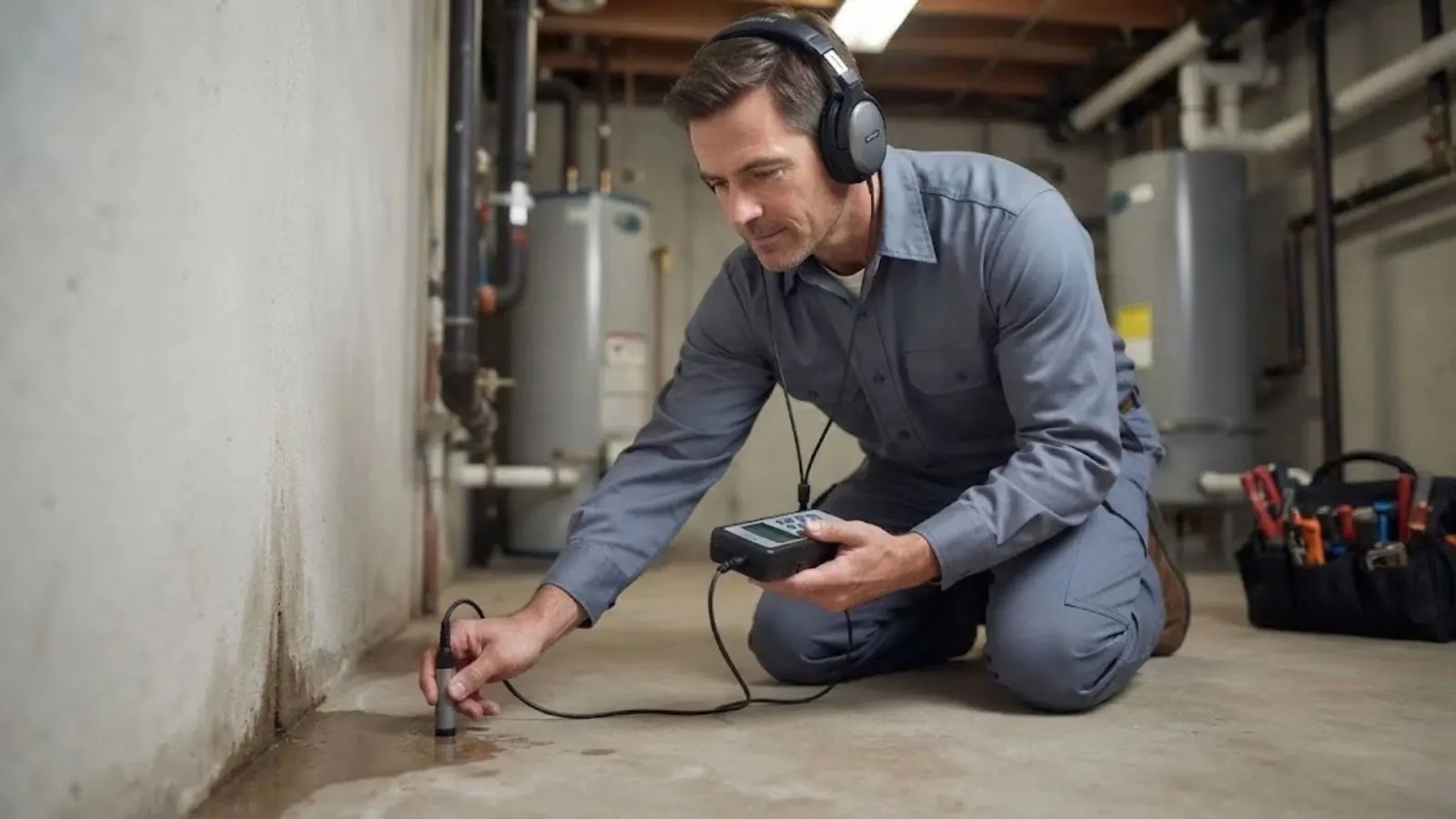
Water on a ceiling, a warm patch on the floor, or a meter that keeps moving is urgent, even when the damage looks small. Emergency leak detection in Dedham, MA means finding where pressurized water is escaping, then fixing only that spot.
Our 24/7 emergency dispatch sends licensed plumbers, and same-day appointments are offered when available. While you wait, shut off the main valve, switch off power to wet areas, and move belongings out of the way.
Water coming through a ceiling or wall right now.
Treat an active ceiling or wall leak as an emergency. Water follows framing and wiring, so the wet spot you see is often several feet from the real source. Shut the main valve, then open the lowest faucet in the house to drain the lines.
If a light fixture is wet or the ceiling is bulging, stay out of that room and turn off the breaker for it. A bulging ceiling can hold a lot of water and may drop without warning, so keep people and pets out from under it.
Ceiling leaks usually come from one of three places: a supply line above, a drain line above, or the roof. A plumber can separate the first two by shutting the supply off and watching whether the dripping stops. If it stops, the leak is on a supply line. If it keeps going after a flush or a shower, it is likely a drain.
Your meter is still running with everything off.
A meter that keeps moving after every tap, appliance, and ice maker is idle is the clearest sign of a leak on your side of the meter. The Dedham-Westwood Water District (DWWD) supplies water in Dedham, and its leak guidance says a higher bill is either caused by a leak or by a change in how much water you use. A running meter at zero demand rules out the second cause.
Test it yourself before you call:
- Turn off every fixture, the dishwasher, the washing machine, and the ice maker..
- Find the meter and note the reading, or take a photo of the dial..
- Wait 30 to 60 minutes without using any water..
- Check again. Any movement means water is escaping somewhere..
This is also the right moment to say what we cannot tell you. DWWD's billing-adjustment policy for leaks is not something we can state, so call the District office at 781-329-7090 and ask about it directly. Keep your meter photos and the plumber's invoice, because they document when the leak started and when it was fixed.
Hidden leak or spinning meter? Talk to a dispatcher now.
Call (617) 752-0573Run the toilet dye test first.
Toilets are the most common quiet leak. DWWD recommends a simple dye test: drop food coloring or a dye tablet into the tank, do not flush, and wait 15 minutes. If color shows in the bowl, the flapper is leaking and water is running into the drain all day.
DWWD says it gives out free leak tablets at its office at 50 Elm St, so you do not need to buy anything. A worn flapper is a cheap fix, and clearing it up first makes every other test easier to read. If the dye stays in the tank and the meter still moves, the leak is somewhere else.
Room-by-room checklist before you call.
- Look under every sink for damp cabinet floors, swollen wood, or a musty smell..
- Check the washing machine hoses and the shutoff valves behind it..
- Look at the base of the water heater for drips or rust stains..
- Press on ceilings below bathrooms for soft or discolored spots..
- Watch the ice maker line and refrigerator water line for moisture..
- Check outdoor hose bibs and any irrigation valve boxes for standing water..
- Listen at night for a faint hiss near walls or the water heater..
Signs the leak is on the service line.
If every fixture checks out and the meter still runs, suspect the pipe between the meter and the house. DWWD lists the warning signs: low pressure, discolored water, water bubbling up in the yard, or an overflowing meter pit.
Low pressure at every faucet at once points toward the service line rather than one fixture. Soggy grass that stays green and wet in dry weather is another clue. Because DWWD owns the main and the street side, ask the District where its responsibility ends and yours begins before you hire any digging. Our water line repair page explains the repair choices once the leak is located.
Under-house and crawlspace leaks.
Homes with a crawlspace or an unfinished basement give a plumber something useful: a clear look at the pipes. Look for wet insulation, mineral crust on joints, and drip marks on the dirt or slab below. A hissing sound near the water heater or main shutoff is worth reporting.
In neighborhoods the Town describes as flood prone, such as Manor, water in a basement is not always plumbing. Groundwater can seep through the floor after heavy rain. A meter test settles it: if the meter is still when everything is off and water keeps appearing, the source is probably outside the pipes. If the meter moves, the source is probably a pipe.
If your house or an addition sits on a slab, the same meter test applies. Slab leaks hide under flooring, so listen for running water you cannot explain and feel for warm spots on the floor, which can point to a leaking hot water line.
Buried line leaks.
A buried leak does not show up on a ceiling. It shows up as a high bill, soft ground, or low pressure. Plumbers use acoustic listening gear and pressure testing to narrow down the location, then confirm before anyone digs.
Massachusetts requires you to call Dig Safe at 811 at least 72 business hours before excavation, and that applies to homeowners too. Municipal water and sewer lines may not be marked, so ask your plumber how they will locate the line. When you call, ask whether the plumber brings listening equipment and how they confirm a buried leak before digging.
Irrigation system leaks.
Sprinkler systems leak at valve boxes, risers, and the connection to the house. A broken head sprays visibly. A cracked underground pipe may only show as a soggy patch or a pressure drop in the zone.
Test each zone one at a time, watching for pooling. Most irrigation leaks are quick repairs once found. Check the backflow preventer too, since the plumbing code requires a backflow preventer or vacuum breaker on hose connections, and a failed one can leak or let dirty water back into your lines.
Pool, spa, yard, and meter-box leaks.
A pool or spa that loses more than evaporation explains should be tested by marking the water line, then comparing a day with the pump on to a day with it off. If the loss continues with the pump off, the shell or a fitting is the suspect. If it stops, the plumbing is.
Water standing in the yard or in the meter box is its own signal. DWWD names an overflowing meter pit as a service-line warning sign, so call rather than pumping it out and ignoring it.
Repair options and honest trade-offs.
Once a leak is located, you usually choose between a spot repair and replacing a section. A spot repair is faster and cheaper but leaves older pipe beside it. If the pipe around the leak looks corroded or thin, a longer replacement may save a second visit.
The Town's Master Plan says 74 percent of Dedham houses were built before 1978, and older homes often carry a mix of copper, galvanized steel, cast iron, and plastic pipe, so a second weak spot nearby is not unusual. Ask the plumber to inspect adjoining pipe before closing the wall. If the same house keeps springing leaks, talk about repiping rather than paying for repeated patches.
What a leak detection visit costs.
- How hard the leak is to reach: open basement pipe versus a line behind finished drywall..
- How many tests the plumber needs before the source is certain..
- Whether the leak is on a supply line, a drain, or a buried service line..
- Drywall, flooring, or insulation repair after the pipe is fixed..
- Whether the visit falls after hours, on a weekend, or on a holiday..
Homeowner policies generally cover sudden and accidental damage rather than wear and tear, so ask your insurer what is covered and whether tracing costs count. Want your real number? Call (617) 752-0573.
What to do while you wait.
- Shut off the main water valve and open the lowest faucet..
- Switch off power to wet areas if outlets or fixtures are involved..
- Photograph the damage and the meter for your records..
- Move furniture, rugs, and electronics away from the wet area..
- Put a bucket or towels under active drips and keep the area ventilated..
Frequently asked questions.
.
Yes. Our 24/7 emergency dispatch takes calls at night, on weekends, and on holidays. We make no promise about arrival time because it depends on the call volume and the plumber's location, but the dispatcher will tell you what to do while you wait.
.
Turn off everything that uses water and watch the meter for 30 to 60 minutes. Any movement means water is escaping. A toilet dye test and the room-by-room checklist above help narrow down where.
.
We cannot state the District's billing-adjustment policy. Call the DWWD office at 781-329-7090 and ask. Keep your photos and invoice handy.
.
Often yes. Meter tests, pressure tests, acoustic listening, and moisture or thermal tools narrow down the spot first. Opening drywall is then limited to the smallest area needed.
.
If your house or an addition sits on a slab, a hidden leak can show up as warm floor spots, a running meter, or sounds of water you cannot explain. A plumber can isolate lines and listen to find it. Repair may mean a spot reroute rather than breaking the slab.
.
Tell your landlord right away and shut the water off if you can do so safely. Landlords can authorize our dispatch, and we can document the leak with photos and a report for them.
.
DWWD owns the main and the street side. The homeowner generally owns from the meter or curb stop to the house, but ask DWWD where its responsibility ends. Our water line repair page covers what to expect.
.
Yes, including Westwood and Needham. See all service areas for the full list.
Codes, standards and sources.
Plumbing work in Massachusetts is governed by 248 CMR 10.00, the Uniform State Plumbing Code, and plumbers are licensed by the Board of State Examiners of Plumbers and Gas Fitters. You can read the state's consumer fact sheet on plumbers and gas fitters before you hire anyone.
Local facts on this page come from the Dedham-Westwood Water District, the Town of Dedham, the other towns named and Mass.gov, and were checked in October 2026. Where a fact could not be confirmed, the page says to ask the utility or the town.