
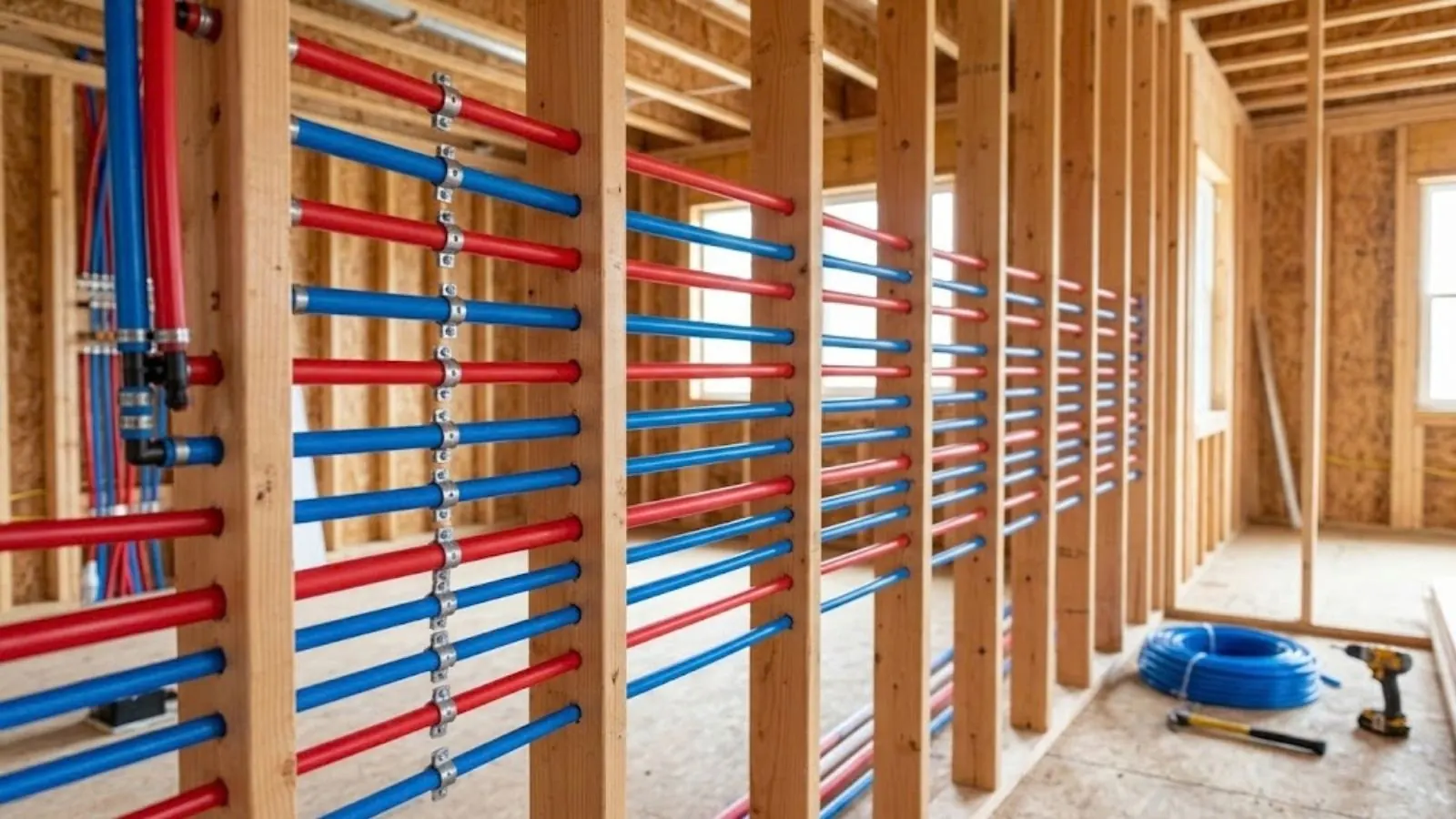
Repiping in Dedham, MA means replacing the water supply pipes inside your house with new ones, either the whole house or a section. It is usually a planned job, not a rush job. Homeowners ask about it after a second or third pinhole leak, after water turns brown, or when low pressure keeps returning.
This page explains how the decision works, what the process involves, and what to ask any plumber before you agree to open walls.
Repair or repipe: a decision framework.
The question is not whether one pipe has failed. It is whether the rest of the pipe is likely to fail soon. Use this table as a starting point, then ask a licensed plumber to inspect your actual pipe.
| What you are seeing | Points toward | Why. |
|---|---|---|
| One leak in a newer line | Repair | The rest of the pipe is probably sound. |
| Several leaks in a year | Repipe the affected run | Wear is spread along the pipe. |
| Brown water from many taps | Inspect, likely repipe | Interior corrosion is common in steel pipe. |
| Low pressure at every tap, house-wide | Inspect first | Could be corrosion or a regulator. |
| Remodel with walls already open | Replace while open | Access costs less now than later. |
A plumber who recommends a repipe after one pinhole should explain what they saw. A plumber who recommends yet another patch after the fifth leak should explain that too.
What older Dedham homes may have inside the walls.
The Town's Master Plan says 74 percent of Dedham houses were built before 1978, and it describes mill-worker housing near Mother Brook and 1950s capes, split-levels, and ranches in the Oakdale area. We do not have a source for what pipe went into homes of a given age in Dedham, so we do not guess.
What we can say is that homes of mixed ages often have a mix of copper, galvanized steel, cast iron, and plastic.
That mix matters because a house can have good copper in the kitchen and old galvanized steel feeding the bathroom. Ask the plumber to identify the material in each run you can reach, and to photograph it. Do not assume from the age of the house.
Questions about repiping your home? Call and talk it through.
Call (617) 752-0573Signs your pipes are wearing out.
- Repeated pinhole leaks or green crust at joints..
- Water that runs brown or rust-tinted after sitting overnight..
- Pressure that has dropped over years, not days..
- Visible flaking, bulges, or rust on exposed steel pipe..
- A new leak soon after a plumber repaired an old one..
- Metallic taste or staining on fixtures..
Galvanized and mixed-material pipes.
Galvanized steel is zinc-coated iron pipe. Over time it can corrode on the inside, narrowing the pipe and shedding rust. If your home has it, expect pressure to be hit-or-miss. When copper is joined to steel without a proper fitting, the two metals can corrode where they meet.
We cannot say how many Dedham homes still have galvanized pipe, because we have no data on that. A plumber can check by tapping a magnet on the pipe, scratching it to see color, and looking at the fittings. Ask them to show you the pipe, not just describe it.
The water itself: what DWWD supplies.
The Dedham-Westwood Water District adjusts pH and uses orthophosphate for corrosion control, so water in Dedham is treated not to eat at pipes. Its 2025 report lists hardness at about 6.0 grains per gallon on average, which is moderately hard. That does not stop old pipe from aging, but it does mean scale can build up in fixtures and heaters.
The same report says lead in drinking water comes mainly from service lines and home plumbing. If you are repiping, ask the plumber to note any old solder joints, and consider asking DWWD about the line from the street. Our water line repair page covers that side.
Full repipe or partial: how plumbers decide.
A full repipe replaces supply lines throughout, typically with new copper or PEX. A partial repipe replaces only the failing run, such as a bathroom branch or a basement main. Partial work is cheaper and less disruptive, but it leaves older pipe behind the new work.
PEX is flexible plastic tubing. It threads through walls with fewer cuts than rigid pipe, which helps in older plaster. Copper is rigid and long-lasting. Ask which the plumber recommends for your house and why, and whether the product is approved under the Massachusetts plumbing code, 248 CMR 10.00.
How the work goes.
- Inspection and a written scope: which lines, which material, which walls..
- A permit is pulled by the licensed plumber through the Dedham Building Department..
- Water is shut off and the old lines are drained..
- New lines are run, often through small access holes in drywall..
- Pressure testing before anything is closed up..
- The Town's inspector signs off, then walls are patched..
Most repipes disrupt water for some portion of a day or longer, depending on house size. Ask for the expected shutoff windows in writing, and ask who patches the drywall. Repiping is a plumbing job, and patching and paint are often separate trades.
Repiping for new construction and additions.
New construction and additions get new supply lines from the start, so the question is material and layout rather than replacement. Plan the routes before framing closes so that shutoff valves, access panels, and future fixtures are reachable. Our plumbing installation page covers that kind of work.
What repiping costs.
- Number of fixtures, floors, and the length of pipe to replace..
- Material choice: copper, PEX, or another approved pipe..
- Wall and ceiling access: plaster, finished basement, or open framing..
- Permit, inspection, and any change to the main shutoff or pressure regulator..
- Drywall, paint, and flooring repair after the pipes are in..
Homeowner policies generally cover sudden and accidental damage rather than wear and tear, so a repipe that replaces worn pipe is usually not covered. A resulting water loss may be. Ask your insurer. Want your real number? Call (617) 752-0573.
What to do before the plumber arrives.
- Take photos of every leak, stain, and the meter..
- Note which taps run brown and for how long..
- Find your main shutoff and test that it turns..
- Clear access to the basement, water heater, and under-sink areas..
- Write down when each leak happened and what was done..
Frequently asked questions.
.
Look for repeated leaks, brown water from many taps, and long-term pressure loss. One failure is not enough on its own. A licensed plumber should inspect the pipe and explain what they found.
.
No. The Town's Master Plan says 74 percent of Dedham houses predate 1978, but age alone does not tell you the pipe condition. Many older homes have had sections replaced already.
.
It is not an emergency by itself, but it corrodes from inside and can restrict flow or leak. DWWD says lead comes mainly from service lines and home plumbing, so ask a plumber to check any old solder and your service line material.
.
Some access is needed, but plumbers often use small openings and fish new lines through. Plaster and finished basements are harder. Ask for a plan that shows where access holes will go.
.
Yes. Replacing piping requires a permit that only a licensed plumber can pull, per the state's consumer fact sheet. The Dedham Building Department's Plumbing/Gas Division handles permits online through OpenGov.
.
Not directly. Report the leaks and brown water to your landlord in writing. The owner decides on repiping, and we can provide an inspection report if they call.
.
Yes, a partial repipe is common. Be aware that older pipe elsewhere may fail later. See leak detection if you want to find what is failing first.
.
Yes, we serve Needham as well. If a pipe has already burst, see burst pipe repair.
Codes, standards and sources.
Plumbing work in Massachusetts is governed by 248 CMR 10.00, the Uniform State Plumbing Code, and plumbers are licensed by the Board of State Examiners of Plumbers and Gas Fitters. You can read the state's consumer fact sheet on plumbers and gas fitters before you hire anyone.
Local facts on this page come from the Dedham-Westwood Water District, the Town of Dedham, the other towns named and Mass.gov, and were checked in October 2026. Where a fact could not be confirmed, the page says to ask the utility or the town.